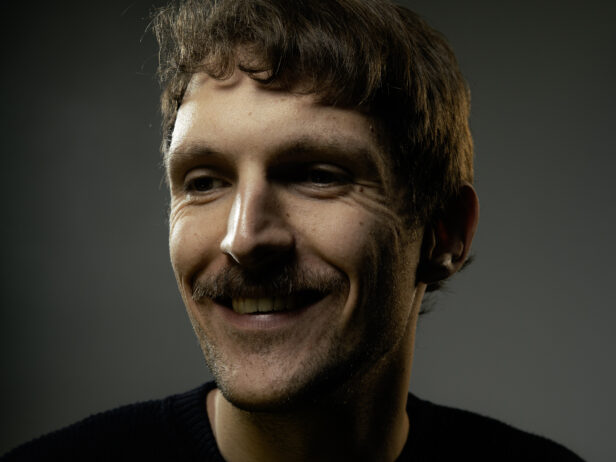
INTERVIEW WITH PEPIJN PEETERS
Pepijn Peeters (Arnhem, 1999) is a Dutch composer who is mainly involved in music for film. He enjoys deep and positive collaboration on projects to fully utilize the narrative and symbolic power of music. Next to his work as a composer, Pepijn is also an arranger, orchestrator and copyist for orchestras and other composers.
– How would you describe your artistic practice today?
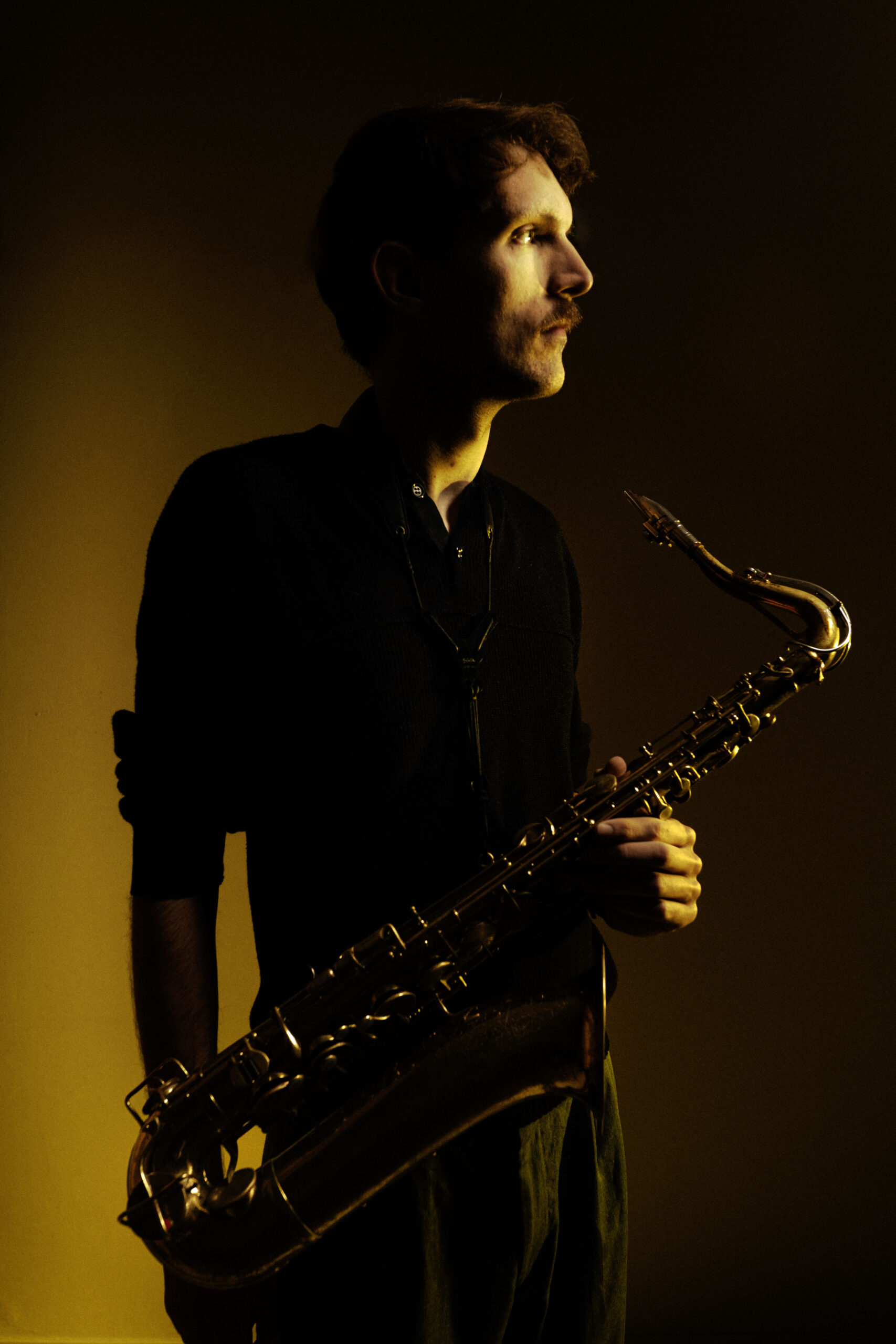
I often call myself a jack of all trades. I compose, arrange, play, teach and produce music. The common theme is that I work for other people. If you need music for something, I’ll write it.
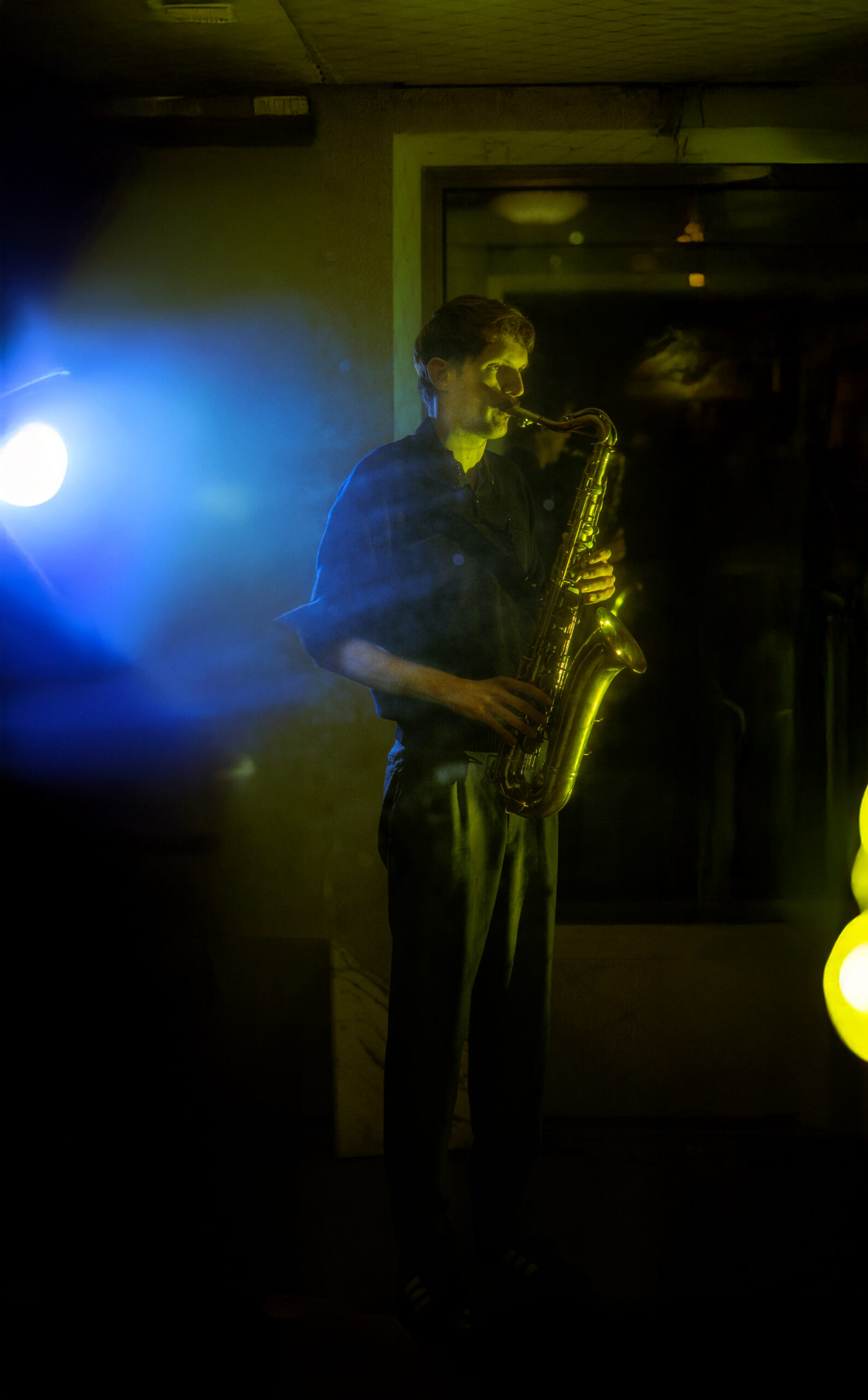
At the moment, I’m scoring a documentary, composing electronic music and sound ambiences for an opera/musical, I write arrangements for live concerts. Next to all the writing, I also teach music and play my sax in different bands and projects, like a theatre show at De Parade this summer.
People also ask me for projects that bring some technical challenges. Like blending loud electronic music with a small acoustic ensemble, or interdisciplinary projects with spatial audio.
– In your bio, you mention that your initial aspiration was to become a music producer. How did you make the U-turn toward music scoring?
As a late teenager I wanted to become a music producer, in a studio with a big desk. Among the things I loved at that time was 70’s disco music with lush horn and string arrangements. I really wanted to learn how to write those kind of arrangements. Another thing I couldn’t stop listening to was an unbelievable album by jazz-fusion group Snarky Puppy called Sylva, which featured the Metropole Orchestra. I just really wanted to learn how to write music like that.
I went to study music production and composition in Enschede (ArtEZ MediaMusic), where I had to choose a main subject, with certain specialist classes. I specifically chose ‘Composing for Film & Game’ because it contained classes on orchestral writing. I just wanted to learn how to write and arrange big orchestral things. I hardly knew anything about writing for film, but I fell in love with the subject within the first few months.
Now, I just love the collaborative nature of scoring. I like playing around with ideas, stories, concepts and writing from that. I mostly work with film makers, but I am also expanding towards theatre.
– Collaboration seems inherent to your craft. On what principle do you select the projects you work on?
At this point, I’m mostly following my instinct. A project has to bring something new for me. That could be working with new people. But it can also mean that I’ll write in a genre I’m not too familiar with, or do certain technical things that I don’t understand yet. If someone has a very good concept but is completely lost on how to approach the music within that project, that’s where I like to get involved.
– How do you build collaboration and communication with a director? What type of exchange do you have—do you receive initial guidance, or do you start from a blank page? Can you share some examples?
This is often the hardest part of my work. Every director is a totally different person and it can be smooth sailing the whole way or it can be a shared struggle to understand each other.
At the first initial contact I preferably don’t talk about music. If someone comes to me and says: “I want you to write 20 minutes of music in the style of Ennio Morricone with 5 violins and a recorder” I try to take a few steps back and ask them why they want this. They can go AI for these specific tasks.
In the beginning I want to talk about the directors motivation, ideas, process and vision. That’s where it starts. I often say yes to a project without having any idea yet of what the music should sound like. If the general concept is strong the music will present itself.
I’m starting on a documentary in the coming days. I haven’t seen any images yet and I have no concept yet of the music. It’s scary, but it’s the best place to start for me. I’ll get a first rough edit, I’ll watch it without any musical agenda, and I will write down my ideas about the story, not the music. After a conversation about this first draft of the film with the director, I’ll start writing. I’ll try to find my own angle. After that, I’ll get a reaction from the director. By the time of the picture lock, I hope to have a strong musical concept and some musical sketches already in the film.
– Can you tell us, based on your experience, a good way to communicate a task to a musician? In a sense, the world of music exists in an abstract realm, and in order to communicate effectively, one has to understand the rules of its specific grammar. But what happens if one doesn’t?
My first advice would be to not use musical terms if you don’t understand them. Misusing terminology often results in confusion.
Another very common thing that people do is using descriptors from other senses to explain music. Words like spicy, warm, bright, big or yellow might make a lot of sense to you, but don’t always mean the same thing to everyone. Musicians do this a lot too, and it’s important that you discuss what elements of the music make you connect these words to it. For example, I’ve had a director tell me once that my demo was too green and it needed to be more dark-blue. This is the moment you need to have a long conversation together to find better words.
Emotional words often work the best: happy, sad, melancholic, curious, sleepy. The more specific you can describe an emotion the faster a musician will know what to do. My film scoring teacher in Amsterdam, Kaveh Vares, often talks about Plutchik’s Wheel of Emotion. Taking a look at this emotional colour wheel will definitely help you to find the right words.
Lastly, use examples. Create a musical mood board. Let your composer/musician also create one and compare the two. You don’t need to look for exactly the music that fits the project (hopefully that music doesn’t exist yet), but you need something that contains interesting and useful elements. It’s very important that you listen to music together and talk about it. This is how you learn each others language.
– Can you share more about your current projects? What are you working on now, and what new directions are you exploring?
I’m trying to expand into the field of theatre. I’m currently co-writing on an opera/musical (opical) with a group of very talented composers. I contribute electronic underscoring and sound ambiences to it. It’s a very high-tech project as well. There will be projections on the stage and a spatial audio system to surround the audience. For me it’s fun, because I have to do a lot of sound designing, but also because I have a director who is also a composer. The communication is so different and I still have to get used to it a bit.
Like I said earlier, I’m starting on a documentary as well. That’s more in my comfort zone. I’m really looking forward to getting some musicians together to play on this score. But I can’t really say anything about it yet because it’s still undefined.
– You are equally involved in composing scores for both documentary and fiction films. Can you tell us if there’s a difference in your approach?
Absolutely. I really enjoy getting involved in a film while they are starting to edit. Documentaries are much more undefined at this stage. The story presents itself during the edit. As a composer I feel I can have more influence on the film itself with a documentary because my ideas can have an impact on the whole concept. With a fiction film I could start writing as soon as there is a script because the story is there. But in reality I often get involved with fiction films once there is a picture lock. Directors and producers are often not thinking about music that much in the pre-production phase. From the moment of picture lock the process is much more comparable between the two.
– Can you share your top five film scores and tell us whether any of them have influenced your own vision for the craft?
It’s always super hard to make a top anything but I can definitely name a few impactful scores that come to mind.
My first obsession with music in a film was Jurassic Park. John Williams just makes you so excited with his energetic music during the ‘journey to the island’ scene. Take the music away and it’s the most boring movie scene you’ve ever scene. It’s rare for a director to leave it all to the composer like that.
Johann Johannson’s scores for Sicario and Arrival inspire me because he creates such a physical reaction with the music. I can really feel this music in my stomach and in my whole body. Especially in the cinema, with all the low frequencies coming from the speakers. I love how cinema can be such a physical experience for the audiences.
The Good, The Bad And The Ugly is one of my favourite scores as well. Many of Morricone’s scores I love just as great pieces of music. This one too, but it also fits so well with the film. From the cartoon style introduction of the characters to the very last scene at the graveyard. It’s just super iconic.
My personal favourite score is Merry Christmas Mr. Lawrence by Ryuichi Sakamoto. I don’t have a great explanation of why I connect with it so much, but I just love his music. It’s very 1980’s and almost fully created with synthesizers. If you listen to the soundtrack by itself I don’t think you’d guess it’s a movie set in a prisoner of war camp in Java during world war 2.
I mentioned five films! Let’s move on.
– What are your thoughts on the Amsterdam art scene? How has being part of WOW Lieven shaped your artistic perspective or professional network?
I’m in Amsterdam mainly because it’s the centre of the film industry in the Netherlands. It’s just really nice to go to a meeting with my bike. In general, I feel there’s so much to do in Amsterdam in any art discipline. This means that there’s a lot of opportunity for new work. But in a way, I feel that this limits my creative world a bit. I lived in Arnhem and Enschede before, and the nice thing about a small city is how easy it is to know what’s going on, and to know almost everyone. If there’s something cool going on, you’ll know about it. In Amsterdam I often feel overwhelmed by all the things that are going on at the same time. For me it actually makes me get out a bit less.
I really hoped that I would make a lot of connections easily at WOW, but so far, it hasn’t really happened yet. This is probably due to my own habits of seclusion. I could create more opportunities to interact with my neighbours because the ones I’ve met so far are really nice people.
– Financial sustainability is a major concern for independent artists. How do you navigate this challenge while staying true to your political and artistic values?
I teach piano and saxophone at a music school for two afternoons a week. That helps a lot with financial stability but it also gives me the feeling of giving something to the community. It also keeps me connected with people who would otherwise not be in my social circle. It also gets me out of my artistic projects for a bit. I think I might go insane without the weekly teaching days.
At the moment I just care that I have enough money to live and that I can do interesting projects. That’s manageable, although I’m a little broke sometimes. I’m just really happy that I can make this work without multiple side hustles. Everything I spend my time on at the moment is music related. That was the dream.
– You recently graduated from the CVA. What has life been like after your studies? What have been the key challenges and opportunities—and how did your master’s experience prepare you for them?
Until some months ago, I was mainly just looking for projects to work on and waiting for opportunities. I don’t feel like my master’s prepared me for that, although my teachers did mention that this is a part of the life of a composer in the beginning.
-What five elements do you consider essential for building a sustainable, long-term artistic practice—both creatively and practically?
- Be a nice person. Nobody wants to work with an asshole. (Similarly, if the person you’re working with is an asshole, try to see it through to the end of the project and don’t work with them again.)
- Believe in your own abilities. People ask you for a reason.
- Build up a financial safety net for yourself. Financial troubles weigh heavily on your mind.
- Stay connected with the rest of society. Do something where you meet people with regular, non-artistic jobs. Stay away from the ivory tower.
- Don’t take your art too serious. Include some humour into everything you make.
– Where do you see yourself—artistically and personally—over the next few years? Do you follow a defined plan, or do you allow intuition to guide your path?
Right now, I’m really following my gut. If something feels good and sounds fun, I’m probably doing it. Learning new things is still my main artistic goal. That’s why I keep doing different and demanding projects.
In a few years, I’d like some bigger and longer projects to work on, preferably a feature length film. It would also be my dream to work on a series. I’d like to have my own ensemble of musicians to write for, record with, and to play some shows.
– How do you recharge creatively and emotionally?
Haha, this is something I could use some advice on myself. I tend to be a bit of a caveman, hiding in my house all day. I think just getting out and seeing friends and family is the best thing.
Some advice for myself: I used to swim a lot. I should start doing that again. Swimming for an hour without stopping can really get you into a meditative state.
– If you could be reincarnated as a plant or an animal, what would you choose—and why?
Anything at the bottom of the ocean. Would be nice to not have to deal with humans.
Photos by Roman Ermolaev
by WOW