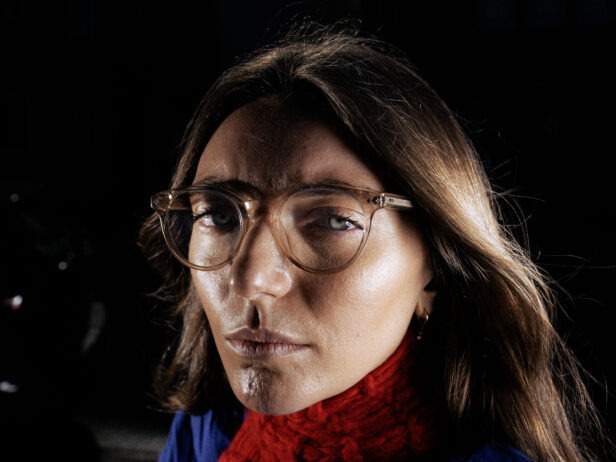
INTERVIEW WITH Chloé Harris
Chloé Harris is a text-based theatre director based in Amsterdam, specialising in the creation absurd theatre that merges striking visuals with compelling storytelling. Her creative process begins with the text and the world of the play, creating mood boards from films and her drawings to create vivid theatrical worlds through close collaboration with her artistic team. Fascinated by the interplay between dreams and reality, she uses theatre to explore the subconscious, uncovering deeper truths about the human experience. In addition to directing, she has a strong passion for translating for theatre, bridging language and culture to bring stories to life on stage.
– How would you describe your artistic practice today? What are the primary themes and questions driving your current work?
I would describe my artistic practice as strange, alien, and deliberately absurd. A space where reality begins to slip and reform. I work primarily from text, often pre-existing plays, but I treat them less as fixed structures and more as living organisms that we will bring back to life. In close collaboration with actors, I dismantle and restructure the order of events, searching for unexpected ways of telling the story. I often merge scenes together, swap characters, repeat physical actions or lines over and over again to create an alien atmosphere.
My work is driven by a fascination with the unstable boundary between dreams and reality. How imagined worlds can feel as convincing and more truthful than lived experience. I am drawn to the idea that fiction is not an escape from reality, but a tool to expose it: that what we invent might reveal more about us than what we perceive as real.
This has led me toward science fiction theatre, creating stories that do not yet exist, but feel uncannily close, as if they are already unfolding somewhere just out of reach.
Within this, time has become a central obsession. I approach it not as linear or chronological, but as something elastic, fragmented, and simultaneous. In my work, past, present, and future collapse into one another, creating a sense of temporal disorientation where multiple realities can coexist. I’m interested in what happens when time loses its stability and how that shift might open up new emotional, philosophical, and theatrical possibilities.
– Can you tell us a bit more about how you start a new work? How do you begin shaping your ideas?
I read a lot of plays. I often browse the theatre bookshops in London until something really sparks my interest. From there, I try to listen closely to my intuition and ask myself: am I in love with this story?
From there, I start building a world around it, collecting images, writing small texts or reflections. To understand why it resonates with me and what draws me to it. That process helps me begin shaping a concept and thinking about how I want to approach the work artistically.
Once the idea feels more grounded, I share it with friends and other artists. Those conversations become a way to test, expand, and evolve the work further.
– You are working as a surtitles translator for Dutch plays—can you share more about this line of your work? How does it affect your own practice?
Translating surtitles is something I fell into during an internship, assisting on Witch Hunt at Noord Nederlands Toneel in Groningen, directed by Eline Arbo. I was then invited back the following season, and since then I’ve continued working with NITE and De Toneelschuur.
What I value most is the chance to observe different directors and processes up close. The translation itself requires precision and sensitivity to rhythm and timing, and it has strengthened both my Dutch and my awareness of language.
It also feeds into my own practice, particularly around accessibility and making me think more consciously about how audiences engage with and understand my work.
– Can you tell us about your studies? What was your experience like? What did you take from your school days, and what did you leave behind after being exposed to the professional field?
I had a really great time studying and felt very grateful to be accepted into the Theatre Directing course at the Academy of Theatre and Dance. It felt like a creative jungle, with endless possibilities to make work.
Coming from the UK, I was aware of how different the training is. Many directors there come through more academic or conservatory routes, whereas AHK was highly practice-based. The directing department didn’t see directing as something that could be “taught” in a traditional way, but rather something you develop through your own process. That approach helped build my confidence and trust in my intuition.
We were also encouraged to think ambitiously. For my graduation piece X, I worked with a London-based sound designer, Johnny Edwards, experimenting with live sound and streaming a band into the theatre, an ambitious and technically complex project that was fully supported by the school and help fund.
Transitioning into the professional field was a reality check. After working in an environment where almost anything felt possible, I found it challenging to scale ideas down and adapt to smaller budgets and teams. Over time, I’ve learned to balance that early ambition with the constraints of the field, finding more precise ways to realise my ideas while still thinking big.
– Can you share more about your current projects? What are you working on now, and what new directions are you exploring?
At the moment, I’m working on bringing my production of Constellations by Nick Payne on tour across the Netherlands. I directed it last year at Toneelschuur Producties, and I’m now exploring how the piece can continue to develop in new contexts and reach different audiences.
Constellations is an intimate story about two people falling in love across multiple versions of reality. Using the framework of the multiverse and ideas from string theory, the play repeats moments with small variations, suggesting that every possible outcome exists simultaneously. Through this, I explore questions around free will and our perception of time, what it means to choose, and how we experience relationships when different versions of them could all exist at once.
Alongside this, I’m increasingly interested in how scientific and philosophical ideas can influence theatrical form, not just as themes, but as structures that shape how a performance unfolds.
Alongside this, I’m currently translating the surtitles for Medea voor een toeslagherdenking, (Medea The Child Benefit Scandal) directed by Angelo Omskerk for De Toneelschuur. I’m creating surtitles both in English and for Dutch deaf audiences. It’s a really meaningful challenge, as the piece engages with the Dutch child benefit scandal, and requires translating not just language but a very specific socio-political context. I’m thinking carefully about how to make this history eligible for non-Dutch speakers, while also being sensitive to the emotional and cultural weight of the event.
– In one of your works, Niemandsland, you mention an anti-growth philosophy alongside the struggle of finding a new way of living. Have you found one?
Good question. Niemandsland and moving into WOW happened one after another, so having stable housing on my own already felt like a new way of living for me. The idea of anti-growth is something I’m still trying to practise more in both my daily life and my work. It’s less about having fully arrived at a different way of living, and more about gradually shifting away from the constant drive to keep producing more and more but rather being grateful for what you have and not sad about what you don’t.
– Your performance X seems to be a starting point for exploring the outer realms of spatial perception. What was the initial reaction to that experience of outer space?
X became the starting point for my exploration into sci-fi theatre, and I’m grateful for it as a moment where I began to identify and develop my own signature. My initial reaction to the theme of outer space was one of unprecedented overwhelm. Space is something we are inherently part of, yet understand so little about. The paradox being surrounded by something so vast and still so unknown, creates a sense of both wonder and unease. It can feel quite unsettling to realise that we live within it, despite its scale and mystery remaining largely beyond our understanding.
– What are your thoughts on the Amsterdam art scene? How has being part of WOW Lieven shaped your artistic perspective or professional network?
I would describe the Amsterdam art scene as small but compact, with many different ways of making theatre compared to the more traditionally oriented approach I’ve experienced in the UK. I find this diversity inspiring, as it allows me to learn from other makers and practices.
Living at WOW Lieven for over a year has shaped how I relate to my environment. It feels like a shared space where people look out for one another, and I especially value the support within the community, which creates a sense of mutual care and collaboration. Artistically, I would like to engage more with my neighbours and the creative community, but due to touring I haven’t been able to attend many of the social meet-ups. I hope to attend the next one!
– Financial sustainability is a major concern for independent artists. How do you navigate this challenge while staying true to your political and artistic values?
Financial sustainability has definitely been a big struggle for me. I’ve always had to combine multiple jobs to get by, and before living at WOW I relied on temporary housing and anti-kraak to keep my rent low so I could make time for my own work. In that sense, anti-kraak really helped me.
I try to find jobs that still keep me close to people in a similar position, or within the artistic field. Now I work as a theatre translator, which has become a valuable side job. It keeps me connected to the theatre world and allows me to observe other makers.
It’s actually the first time I’ve felt a sense of financial stability, which is quite a new and really welcome feeling.
– What five elements do you consider essential for building a sustainable, long-term artistic practice—both creatively and practically?
1.Affordable and stable housing
Having a space to call home is fundamental. It provides me stability needed to think, create, and sustain a practice over time.
2.Motivation and perseverance
The process can be challenging, and not everything works immediately. It’s important to keep going and trust that something meaningful will always come out of the work.
3.Patience
Ideas take time! Especially in theatre, where projects and residencies are often planned years in advance. Patience allows ideas to mature and gives me space to grow alongside them.
4.A community of other creatives
Being surrounded by people who inspire, challenge, and question my ideas is crucial. It pushes me beyond my first instinct and helps deepen the work.
5.Financial support
As simple as it sounds, money is essential. Funding and grants are vital for emerging artists – not only to sustain themselves, but to fully realise the scale and potential of their ideas. As my acting teacher once said, ‘If you have an idea, money will always follow.’ And so far, that has proven to be true for me.
– Where do you see yourself—artistically and personally—over the next few years? Do you follow a defined plan, or do you allow intuition to guide your path?
Over the next few years, I see myself as a maker within a production house in the Netherlands, developing my work and focusing on my fascination with sci-fi theatre. I’m particularly interested in experimenting with classical plays – bringing the past and setting them into the future, and using these texts to explore present contemporary questions.
At the moment, my focus is continuing the trajectory of Constellations by Nick Payne, which I directed last year at De Toneelschuur in Haarlem. I plan on taking this tour around The Netherlands. That process feels like an important foundation for where I want to go next.
Alongside this, I’m currently moving between the Netherlands and London as I begin to establish my career in the UK. As it’s my home country, I feel a strong need to return and build a presence there.
In terms of how I navigate my path: I do have clear artistic goals, but they are guided by intuition. I bring my past and present into dialogue to shape my future, reflecting on my previous work and current interests to understand what I want to make next. My intuition plays a key role in this process; I listen to it closely as a way of moving forward. So while there is a direction, it remains open, responsive, and evolving.
– How do you recharge creatively and emotionally?
It really depends on my mood. Sometimes I need to be completely alone to recharge. Those moments are important for me to reset. I’ll knit, play on my Switch (I’m a big Zelda fan), read, watch films, go for a run or take a day off to go to the spa.
Other times, I recharge through connection. I’ll go to my knitting club, watch a theatre show, or go out dancing.
I think I move quite fluidly between solitude and community, depending on what I need emotionally and creatively at that moment.
– If you could be reincarnated as a plant or an animal, what would you choose—and why?
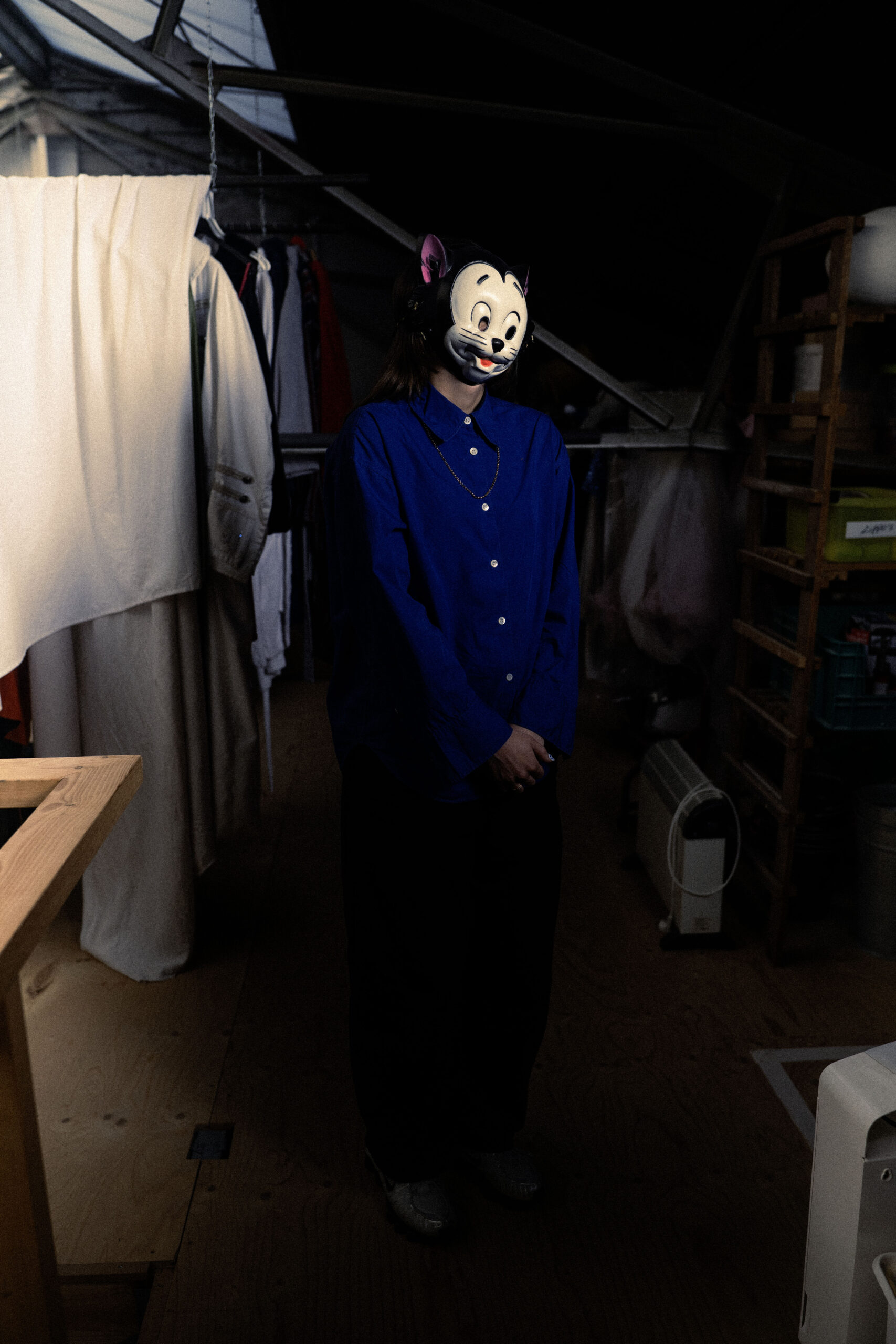
It would have to be a cat: they are smart, independent and inquisitive creatures.
Photos by Roman Ermolaev
by WOW