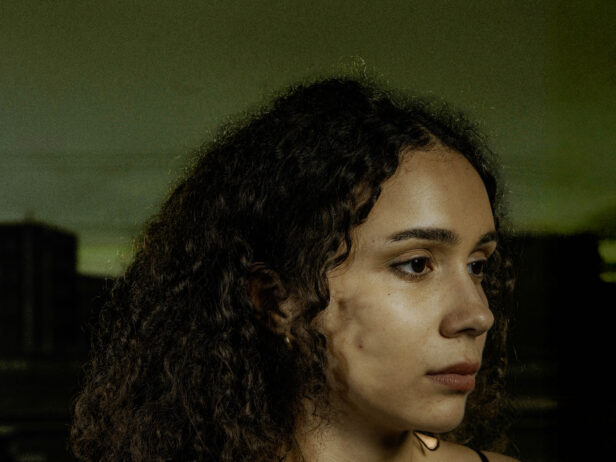
INTERVIEW WITH DELFIN LEV
Delfin Lev is a creative producer, filmmaker and researcher based between Amsterdam and Istanbul.
In dialogue with cultural tropes, she crafts meditations on fractures of space and feminine identity within inherited power structures.
– How would you describe your artistic practice today? What are the primary themes and questions driving your current work? What new directions are you exploring?
Everything I make returns to the question of how we live inside power structures. My earlier work focused on spatial politics, on how power is built into places like the home, the gallery, the museum, or the church and how these spaces are never neutral in the way they organize who is visible, who is comfortable, and who is not.
Lately, I’ve been working more with the cultural forces that shape and constrain the experience of womanhood. We move through a world that is not designed for us to go directly after what we want. Of course we can vote and open bank accounts now, but what we inherited is a better-camouflaged version of the same old misogyny. Do I resent it? Yes. But I’m more interested in the negotiation, in moving against the stream of power.
It is not about pointing the finger at “the system” at large or blaming anyone in particular. Power is negotiated when a woman remains in a space not built for her comfort and learns how to exist inside it anyway. It also happens when an institution appears open, but the people inside develop personal strategies of endurance, intimacy, and survival. And sometimes power shifts when a body behaves in a way a space did not anticipate, when meaning changes not through confrontation but simply through presence. And these are the stories I would like to tell.
– You’ve been working in a commercially oriented film production company. How was that experience? Did it drain your soul, or were you able to benefit from it and move forward on your own path?
Producing teaches you to act on ideas, to accept that there is never a perfect moment, and to turn concepts into workable steps with a team. It taught me not to get too caught up in perfecting the idea, but to think in real-life terms, negotiating between ideals and available resources.
I still freelance as a producer in film and advertising, though I’m taking on fewer jobs because of the research master at Filmacademie.
– Can you tell us a bit about your latest project? There are people dancing in a church, right?
Actually, it’s a workout! 🙂 But yes, we made a short documentary on 16mm about the future of churches. In Amsterdam they’re no longer untouchable monuments and are already being used for cultural life. We approach the film from an urban design perspective. These buildings were meant to be the connective points of cities, places where people moved through a shared space before returning to private life.
What happens when a city is no longer religiously homogeneous? How far can we stretch the function of a monumental building? And how do these spaces change as culture evolves? With cities running out of room, those are interesting questions to ask.
– Collaboration is intrinsic to the medium of film. Can you tell us more about how you collaborate and with whom?
Someone I collaborated with recently said something which changed my mind about this.
He said, I want you to trust my vision even if I were going to use the picture of a monkey in the poster. I want you to be able to have faith in what I see in it.
I think this is a good analogy for collaborations. Most works wouldn’t be possible without the amazing people I’ve collaborated with. But if you are going into a project with a collaborator, it is not enough to be excited about the same idea. You have to have complete faith in their vision and vice versa.
– You initiated Circulo Roto, a project that highlights the work of young filmmakers. How is the field doing at the moment?
We receive a lot of interesting work every time. I think it’s interesting times for the medium, because the tools are widely accessible, you can teach yourself how to work with a given medium. It allows people to follow their intuition more organically, and there is a deviation from more traditional narrative forms we see in film. One thing I learned from programming CR is that audiences are far more forgiving than filmmakers tend to think. If you’re honest about what you’re interested in and make a film that you yourself would enjoy watching, you’re already on the right track. It doesn’t take a big budget to execute this.
– You recently began your master’s at the Film Academy. How is it going, and why did you choose to study there?
I learned filmmaking mostly on set, starting quite young, so the master’s feels like a different kind of education. It’s given me space to step back and understand what connects the work I make. Being surrounded by mentors who take time with your questions and your process has been grounding.
– What are your thoughts on the Amsterdam art scene? How has being part of WOW Lieven shaped your artistic perspective or professional network?
I think Amsterdam’s art scene is far more horizontal than most European capitals, and cultural institutions and funding bodies make it possible to actually make things. In that sense, it feels less about who you know.
Living here has given me a wonderful community, with all these great artists as neighbors and many good friends among them. You never feel alone in what you do.
– Financial sustainability is a major concern for independent artists. How do you navigate this challenge while staying true to your political and artistic values?
If we tracked the hours we put into artistic projects we would all unionize against ourselves.
I try to be pragmatic about money so I can hold space for my creative process free from immediate financial expectations, and make exactly what I mean to make. It is a long term investment.
It’s a challenge to always make money in complete alignment with political values, but it is easier to spend it in alignment.
– What five elements do you consider essential for building a sustainable, long-term artistic practice—creatively as well as practically?
- Detaching from effort. Sometimes a sudden idea makes great artwork, and sometimes months of labor lead nowhere. Being able to let go of what isn’t working matters.
- Community. Being there for the people you care about, and letting them be there for you.
- Noticing self-sabotage. Getting honest about how you betray yourself.
- A sense of urgency. Not waiting for ideal conditions.
- Resisting cynicism. Allowing yourself to get excited about other people’s work.
– Where do you see yourself, artistically and personally, over the next few years? Do you follow a defined plan, or do you let intuition guide your path?
It’s very simple, actually. I want to keep making films and stay close to the people I love. I’m currently developing a feature that I hope to shoot in Turkey in 2027, so that’s the direction I’m working toward.
– How do you recharge creatively and emotionally?
I’m still figuring that out 🙂
– If you could be reincarnated as a plant or an animal, what would you choose—and why?
I think cats have it pretty good. I wouldn’t mind being a cat..
Photos by Roman Ermolaev
by WOW