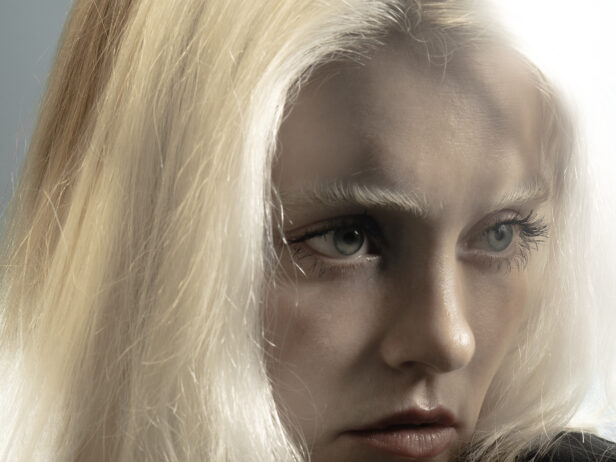
interview with Sabine Pendry
Sabine Pendry is an American performer, theatremaker, vocalist, and sound artist based in Amsterdam. She earned her BA in Performance / Musicology, Sociology and Anthropology from University College Roosevelt, while training as a Classical singer at the Fontys Academy of Performing Arts. After graduating from the re:master Opera program at the Sandberg Institute in 2024, she began developing independent stage work, moving between composing, (play)writing, directing and performing.
With sound and language as driving forces, Sabine builds precise, eerie, interior, and constricted theatrical worlds. As a maker she strives for atmospheres that hover between séance and confession, with stark stage images and the sung voice at the center. Her work explores themes of grief, obsession, faith, death, and the absurd — and the the way these phenomena are mediated, performed, and codified in contemporary culture. Sabine has performed in festivals and venues such as O. Festival, Rewire Festival, Opera Forward Festival, Frascati Theater, Amsterdam Fringe Festival, the Concertgebouw, Venice Film Festival and Nederlandse Film Festival. She is a member of the re:master Opera performance collective.
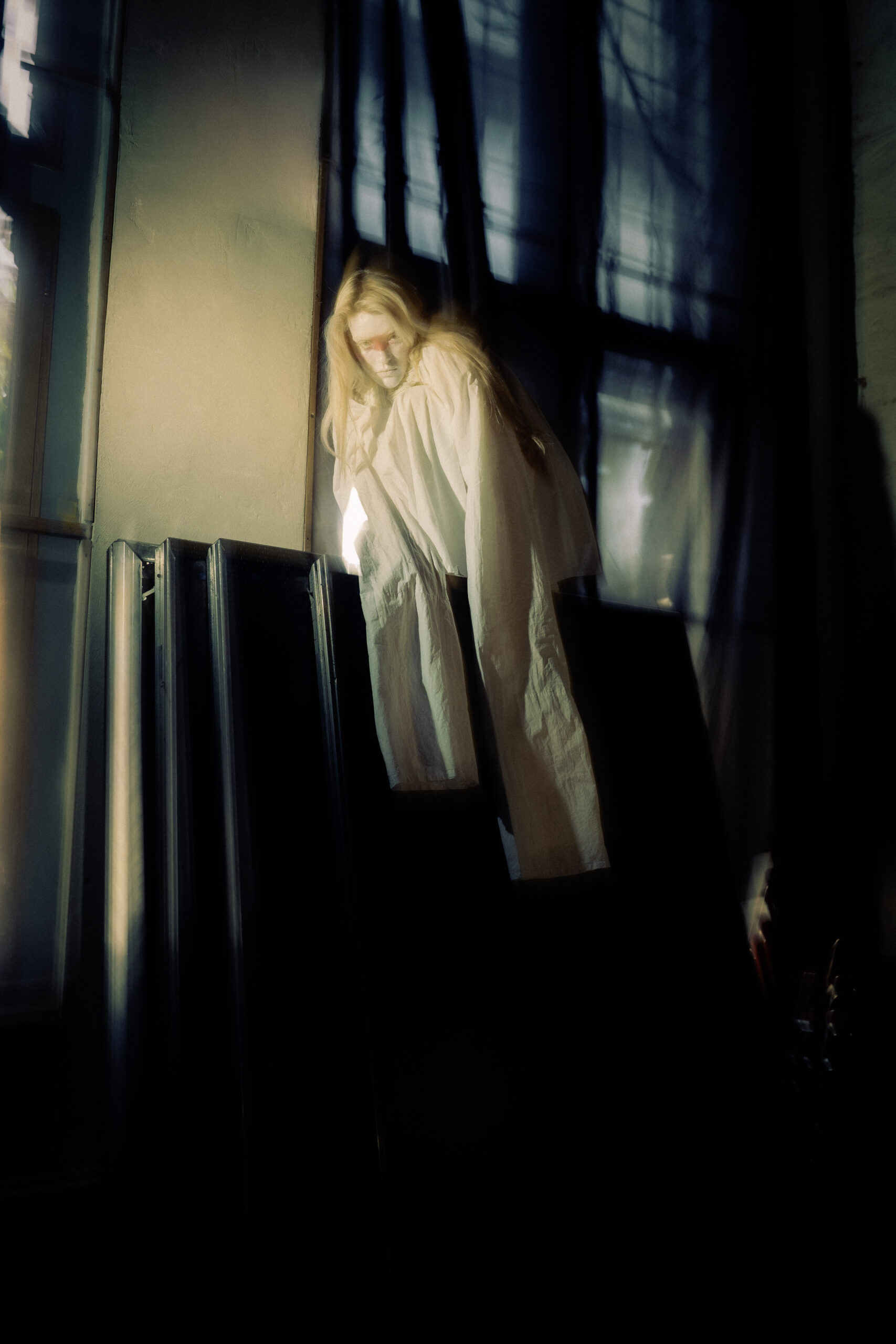
– How would you describe your artistic practice today? What are the primary themes and questions driving your current work?
My practice sits somewhere between theatre, music, performance, and writing. I usually start from sound, song, or text, and build a stage world around that. I’m interested in what happens when ‘singing’ becomes more than a purely sonic act. For me, there’s always a theatrical action or image implied within a sound, and I like to experiment with that relationship.
My process usually starts in quite an internal and intuitive place: my own voice, my own personal thoughts, a recurring reel of melodies, sentences, sensations that won’t leave me alone. Making a piece is usually the process of teasing out how these fragments are related, and trying to translate them into form and fiction. If I do a good job, what starts as something personal eventually grows into something with broader human themes and sociopolitical questions. I’m not necessarily aiming for catharsis, but I am interested in what happens when an emotion is stretched, exaggerated, explored to its limit until it starts to mean something else. Maybe that’s the real engine of the work: taking something private and letting it mutate under the lights until it becomes unfamiliar, conceptual, fictional, or political.
Lately I’ve been preoccupied with themes of grief, alienation, futility, death, communication, and the absurd. I’m interested in people, their complications, the ways they cope with the world, the things they do in order not to be alone, the ways they create meaning or connect to the divine. I’m realizing that, for someone who’s not religious, my recent works all somehow have a bit of a sacred undertone. I create these claustrophobic, devotional spaces where singing or speaking becomes a kind of plea, survival act, or a ritual. I guess I am fascinated and deeply moved by the idea of music and performance as a sort of conjuring.
– Humour plays a significant role in your work. Would you say that this element serves as a coping mechanism for the chaotic world we live in? If so, how effective do you find it to be—and would you recommend it to others?
Absolutely. I think humour is one of the funnest ways to deal with chaos. But I don’t use it consciously as a coping mechanism; it just appears, usually at the moment something becomes unbearable. In my work I hope that when I perform something vulnerable or even grotesque, the laughter it provokes isn’t only amusement but also recognition; a kind of shared embarrassment. I like when humour slips in at the wrong moment, or when something that’s meant to be funny is actually deeply, horribly sad at its core – because I think that’s often when something is just true.
– Collaboration seems inherent to your craft. How do you find and connect with the people you work with—your crew and collaborators?
So far, most of the people I work with are also very good friends of mine – or, we already have an inkling from the jump that we will really get along artistically. For me collaboration is about trust, and also about allowing conflict. I love when people care so deeply about the choices that there can be disagreement, because it means things are alive. It also means that I can extend the world of the piece beyond my own perspective, which I find extremely valuable and humbling. I tend to like a lot of precision and control in my own method, so I’m very grateful when I can work with people who challenge that, while also not judging me for it. Especially when I’m working with personal or vulnerable material, inviting others into the process always brings new angles that I couldn’t have come up with on my own.
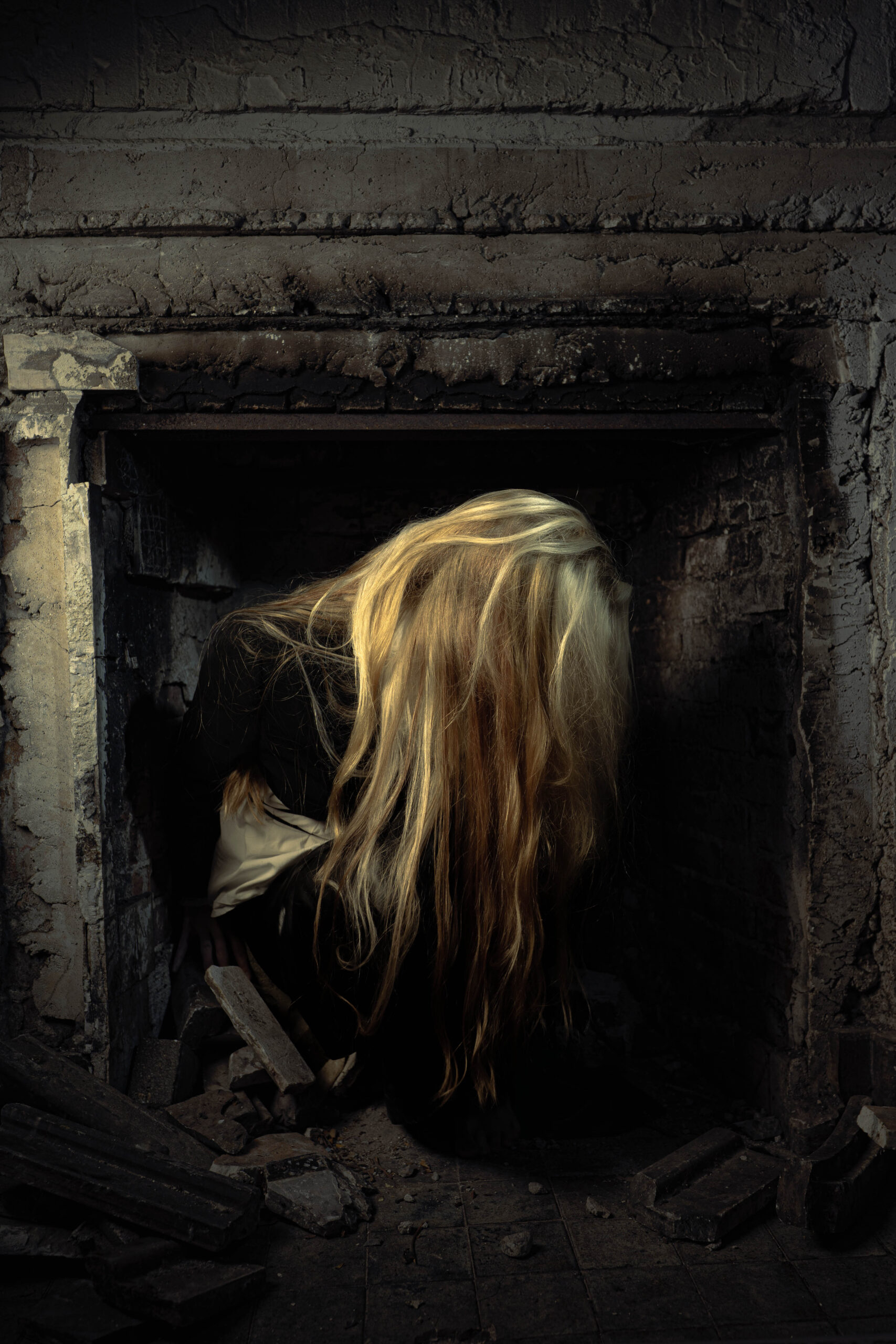
– In your recent performance “Songcycle for a Sad Clown,” you handed the role of director to your colleague Ari Teperberg. Can you share what led to this decision and how the collaboration evolved during the creation of the piece?
Ari is a very dear friend of mine and as far as I’m concerned he is the Prince of the Theatre, so I’m very grateful I’m able to work with him and learn from him. In general, since I perform my own material, there always comes a point in a process where I need someone holding it from the outside so I can perform – so I’m not the only one analyzing my actions and what they mean. I really trust Ari’s sensitivity, clarity, and inventiveness as a dramaturg; he listens to what the material wants. He also knows me personally and worked on my previous piece, so he was able to draw connections in my own music that I couldn’t see myself. And, as someone experienced in opera, he has a very distinctive approach to time-based, music-driven work which really expanded “Songcycle” conceptually. And finally…he understands the importance of tomfoolery and committing to the bit.
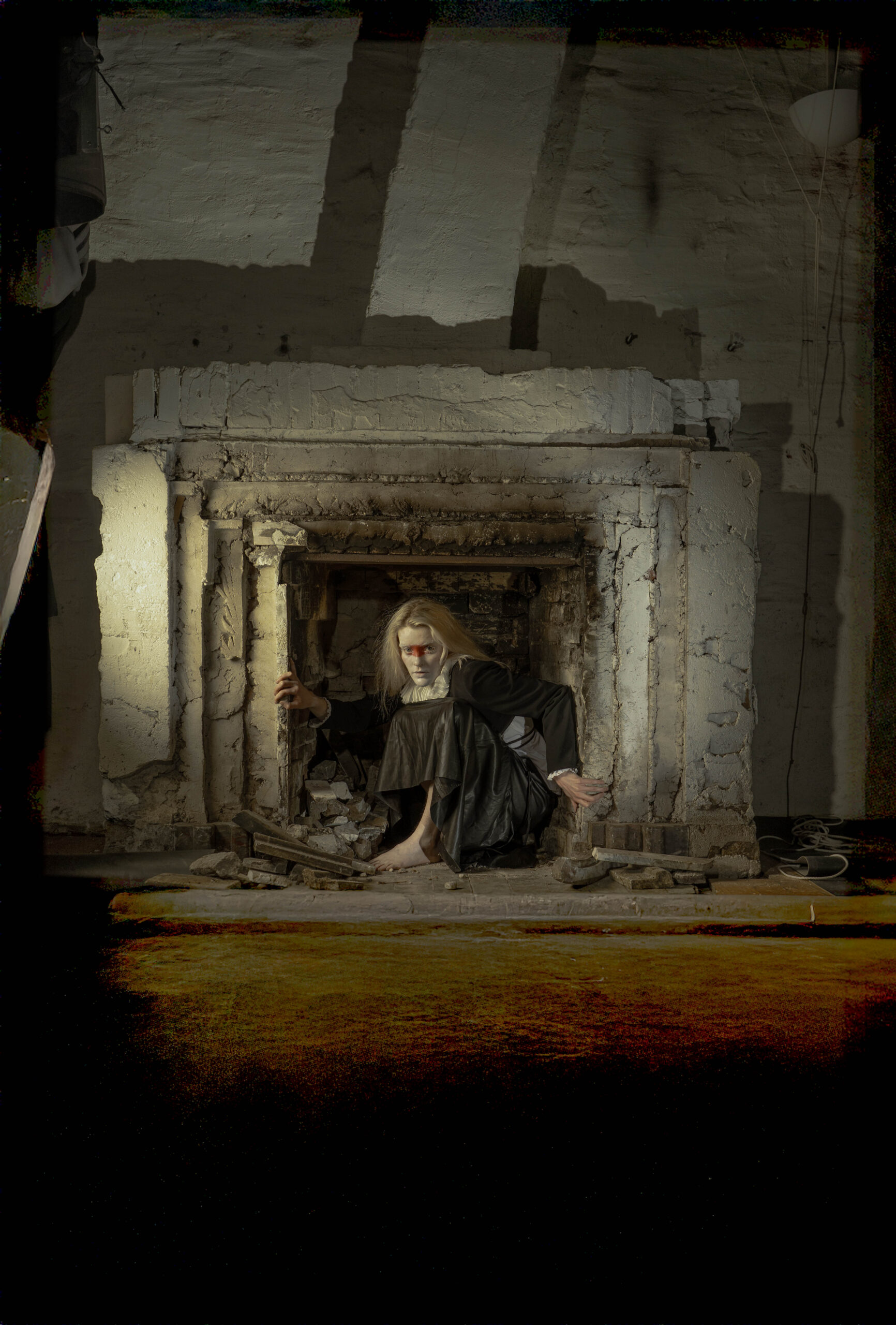
– You describe yourself as a performer, theatre-maker, vocalist, and sound artist. How do you balance these different aspects of your practice?
I don’t really balance them; I think they bleed into each other. When I’m composing, I’m already imagining movement and image and vice versa. And maybe because I’m a singer, words and melody are also often inseparable for me. For me there is an inherent melody and rhythm implied in a word or a phrase, and the materiality or sound of language is equally important as its meaning.
I like to think all this mixing is a good thing, but of course it’s also a challenge when performing your own work, moving between instinct vs. analysis. I’m still learning how to give each aspect of my practice enough distance to breathe. Collaboration helps with that, and so does time – my aim is to get to a sustainable rhythm where I can experiment deeply, and then step back and understand what happened.
– Your work spans several disciplines, each with a rich artistic genealogy. Could you tell us about some of your inspirations and influences?
I love Fiona Apple. I’m very influenced by confessional sadgirl music along those lines. I’m also very influenced by Baroque and Renaissance music, Bulgarian National Choir, and American country and folk music. At the conservatory I was exposed to a lot of classical music as well as contemporary / experimental vocal repertoire which still has a lot of influence on me, especially Luciano Berio’s Sequenza III and John Cage’s Wonderful Widow of Eighteen Springs. I feel very connected to Celtic and Appalachian folkloric melodies. I guess because I am American, I do love Broadway and trashy TV shows about American adolescence. A few artists/composers/playwrights/ writers I like, including but not limited to: Sarah Kane, Caryl Churchill, Tennessee Williams, Samuel Beckett, John Osbourne, Tony Kushner, Shakespeare of course (sorry), Robert Ashley, Christoph Marthaler, Jean Rhys, Ed Atkins, Leonard Bernstein, Hans Abrahamsen, Lingua Ignota, Mary Gaitskill, Jennifer Walshe, Han Kang, Clarice Lispector, Joan Didion, Joyce Carol Oates, David Foster Wallace, Ottessa Moshfegh.
– Can you share more about your current projects? What are you working on now, and what new directions are you exploring?
I’m curently working on a few projects where I’ll be performing for other artists, further developing “Songcycle for a Sad Clown,” and slowly starting research for 2 new pieces, the contents of which will remain secret.
In the coming period I’m hoping to push my practice toward bolder, stranger, more ‘embodied’ territory – allowing the work to be riskier, to take more time, and to inhabit discomfort or tenderness without immediately explaining it away. I’ve also been curious to see how my practice develops if I separate music from theatre for a while, and explore those realms more independently. Musictheatre is a cruel mistress… It’s highly possible that I won’t be able to resist her in the end. But I’m curious how things might grow if I switch it up.
– What are your thoughts on the Amsterdam art scene? How has being part of WOW Lieven shaped your artistic perspective or professional network?
I love Amsterdam. It feels extremely intimate and small as an art scene. It can feel a bit insular or echo-chambery or lonely at times, but I think that’s the case everywhere. Being at WOW Lieven has been grounding for me. It’s one of the few places in the city where you can actually live among other artists, and live affordably. I’ve met collaborators, friends; it makes the act of making less solitary.
– Financial sustainability is a major concern for independent artists. How do you navigate this challenge while staying true to your political and artistic values?
I’m much better at staying true to my political and artistic values than I am at financial sustainability. I’m really into ‘stubborn idealism’ right now, which means I’ll apply for everything I can, but I never want the logic of funding to dictate the logic of the work. I also try to maintain a connection with other artists and communities who support one another regardless of funding schemes or institutional frameworks…I think that’s how an independent scene is built.
Also, I teach. If you want singing/vocal lessons, hit me up!
– What five elements do you consider essential for building a sustainable, long-term artistic practice—both creatively and practically?
Community, discipline, integrity, patience, and whimsy.
– How do you recharge creatively and emotionally?
I giggle and act a fool with my friends, I go see other people perform, I eat a lot and sleep a lot, and I read a lot of books.
– If you could be reincarnated as a plant or an animal, what would you choose—and why?
Maybe a jellyfish. Transparent, rhythmic, a little dangerous if you touch it wrong..? I feel like they exist completely on instinct; no thoughts.
Photos by Roman Ermolaev
by WOW