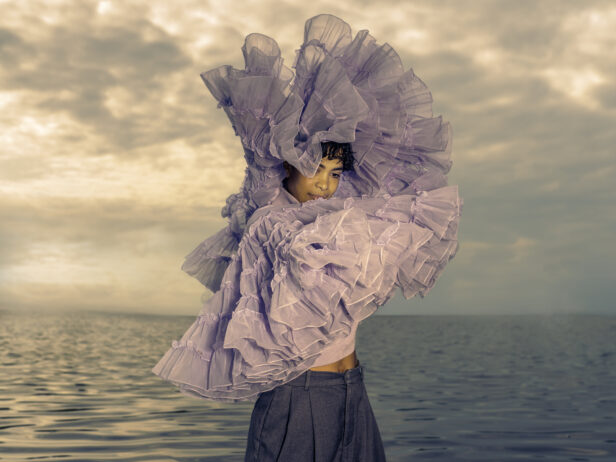
INTERVIEW WITH Michèle Boulogne
Michele Boulogne is a Martinican artist and researcher. Her practice investigates how identity and cultural memory are shaped through spatial sciences. Drawing from the histories of textiles and visual arts, she explores how distant geographies, astronomical phenomena, and large scale natural events, often perceived as too remote, too vast, or too abstract to grasp, become embedded in material culture and collective memory. What lead them to ultimately shape the identities of those who inhabit, represent, or narrate these landscapes? Influenced by her Caribbean heritage and space studies, her work often takes the form of visual collages, layered compositions that mirror fragmented histories and overlapping temporalities.
She combines artisanal and industrial textile techniques such as weaving, knitting, and dyeing. Her practice frequently challenges dominant narratives and cartographic conventions, working with tools like remote sensing, weather imaging, and celestial observation.
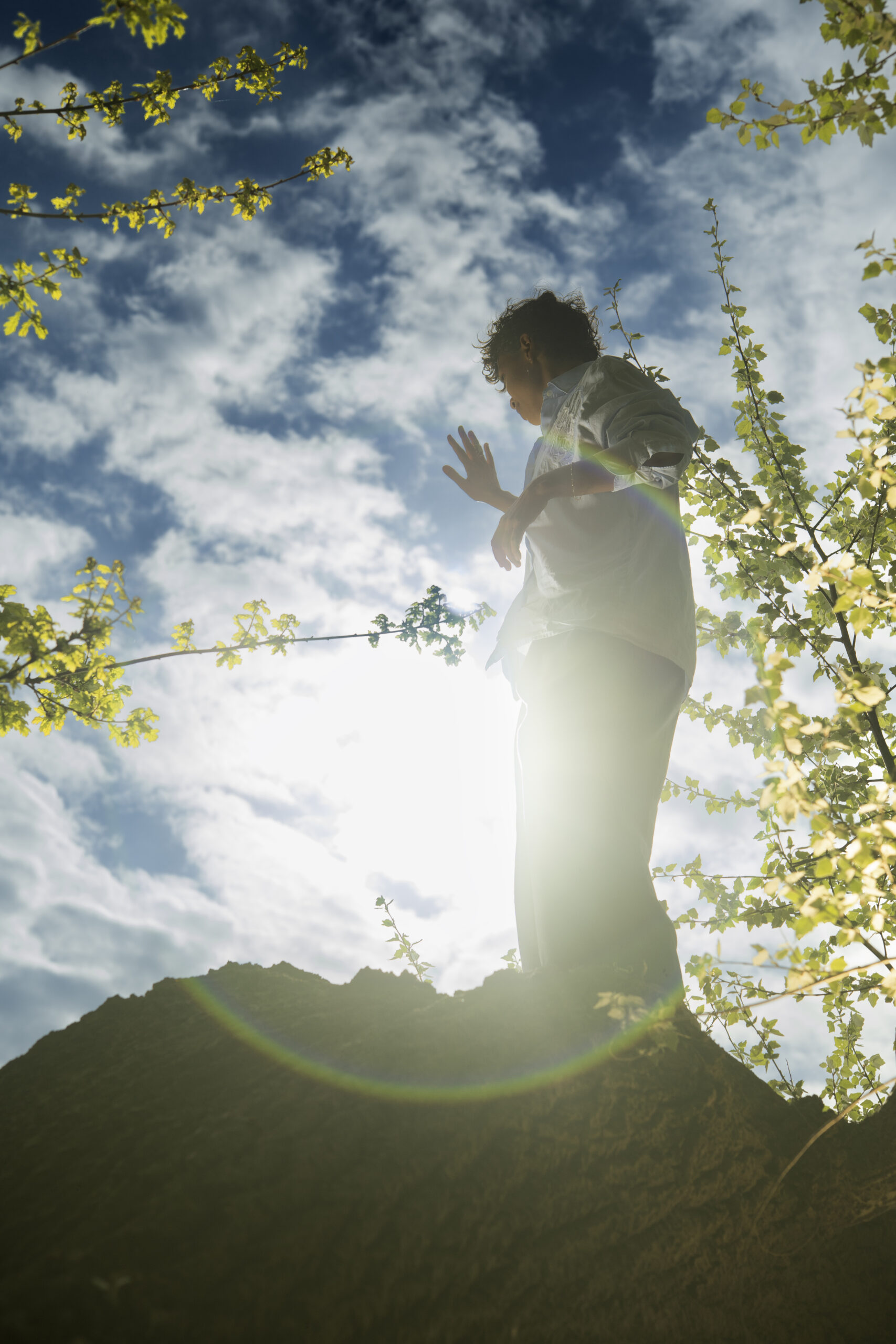
How would you describe your artistic practice, and what are the primary themes in your work?
My practice is a mix between visual and tactile research on geography. It addresses the history of spatial sciences using textiles, archive research and many cross-field experiments. I am basically captivated by mapping, the construction of travel narratives, and the role of artists, artisans and scientists in shaping these stories leading to an understanding of the ecosystems we inhabit. In the past five years I have developed projects on the various missions that have gone to Venus and their cultural impact on cosmology. Sometimes I connect space endeavours to history of exploration of my home region, the insular Caribbean. It is an exciting exercise because I often wonder, since they have both been considered “Next frontier” by Euro-American powers, how much one can inform each other. The frontier between what is “in space” and “on earth” is getting more and more porous, and I like to stand in this grey zone. Sometimes I will focus on very specific places and individuals, yet this sense of connection to something greater will stay present.
I like to use textiles as signifier for the stories of human movement I am trying to tell. Fabric, fibers and dyes were part of the first goods to be traded, sold, shared knowledge upon and their production says so much about land use. They hold these two scales I just told about : the individual aggregated with land and culture.
You work a lot with the topic of space as a new frontier using a decolonial toolset. How did you begin exploring this subject? When was the first time you “looked up”?
In Martinique you don’t even need to look up to see the night sky. You can already look in front of you and you’ll see the stars! So, I guess astronomy as a practice thus came before I can even remember. As a topic though, it developed when I took a deep dive in the history of human mobility and knowledge transmission. We know very little about the universe we inhabit, what we know already help to understand many temporal and material layers of the planet we live on. Yet there are very specific sets of agendas put upon outer space as territories to exploit, extract and reinforce terrestrial dominance. I wish the decolonial toolset was not needed anymore, but the topic I address can not go without it and there is still so much to fight for. Of course growing up in the islands makes you witness at a way too early age the violence of colonial regimes and their long-lasting repercussions. I believe that the context in which I grew up made me more literate in recognizing it, with a dash of mistrust. This decolonial work is undoing, the toolset builds, I am not using it creatively I am using it because I know it’s the right thing to do. This is quite hard to navigate as an artist. I’m using it because it’s the only ethical response to the histories I know. And that makes it difficult to navigate in the art world sometimes.
In most of your works, we see a strong emphasis on technique and craft alongside conceptual depth. What motivates this union of skill and idea?
For me, the relationship between technique and concept are never separate – and that’s not unique to art. In science and engineering too, the medium shapes the concept. The way knowledge is structured, visualized, or built materially has always influenced how it’s understood.
This is the core of what I have been exploring, I often think of 16th- and 17th-century atlases of the Americas, these heavy, elaborate objects stored in European libraries. They weren’t just maps; they were tools of imagination and world-making. Their materiality, the scale, printing, binding, and decorative choices shaped how the American space was conceptualized. Today, I see similar dynamics in platforms like Google Earth or the way planetary surfaces are visualized using satellite data. These systems translate information into images that feel photographic or objective, but they are highly curated. What we see, and what we don’t, is shaped by technical filters, naming conventions, and embedded agendas.
I think that’s also where the decolonial dimension of my work connects to craft. Decolonial thinking asks us to reconsider what counts as knowledge, and how this spatial knowledge is built.
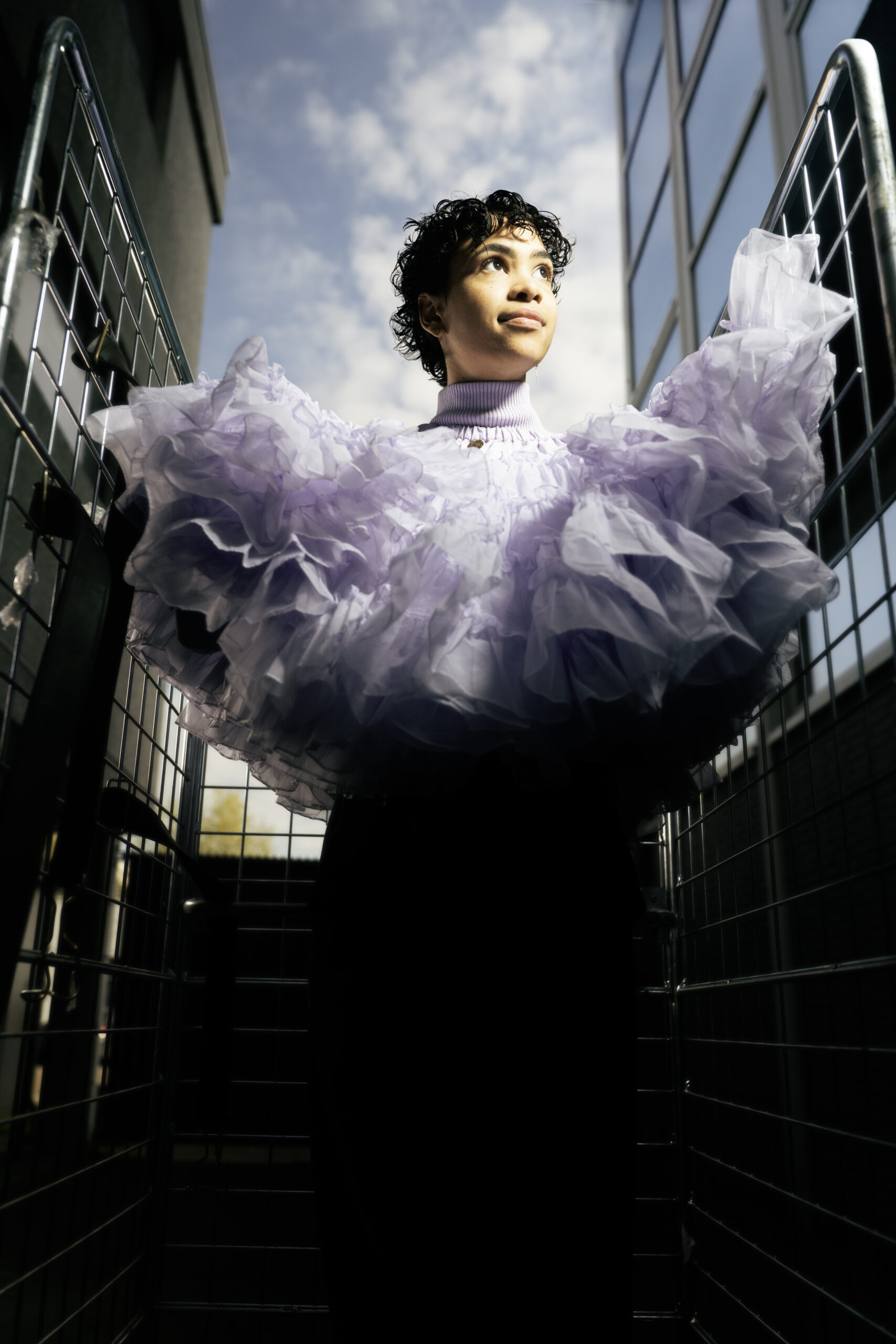
What projects are you currently working on, and what inspires you these days?
I have lately been inspired by the smell of thick ink at AGA Lab, by onigiri with kombu and a form of end of the world as we know it. In the midst of that, I am finalizing a series of work titled An Mitan: The Space Between Islands that includes prints, basketry experiments, and a publication I’ve been developing with my mother, Marie-Line Mouriesse Boulogne. She is an anthropologist and lives in Martinique. I’ll be showing most of it this autumn throughout Amsterdam during the GLUE Design Week and the AFK Talent Festival – you should pass by!
To introduce it very shortly: it’s a form of manifesto. An Mitan is co-authored with my mother and grew out of long conversations between us, where my research into material practices and space technologies met her reflections on the impact of colonization on Kalinago knowledge and presence in the region. The term means “at the center of” in creole, and holds our desire to reconnect with the land, while acknowledging the deep complexity and violence that still shape it. We think the Caribbean is a region that has to culturally and geographically reconnect to each other in order to face climatic challenges and to simply build beyond.
This project has been a ride honestly, it is the first time I do something as personal, yet connected to tech and family and with so much writing (in two languages!).
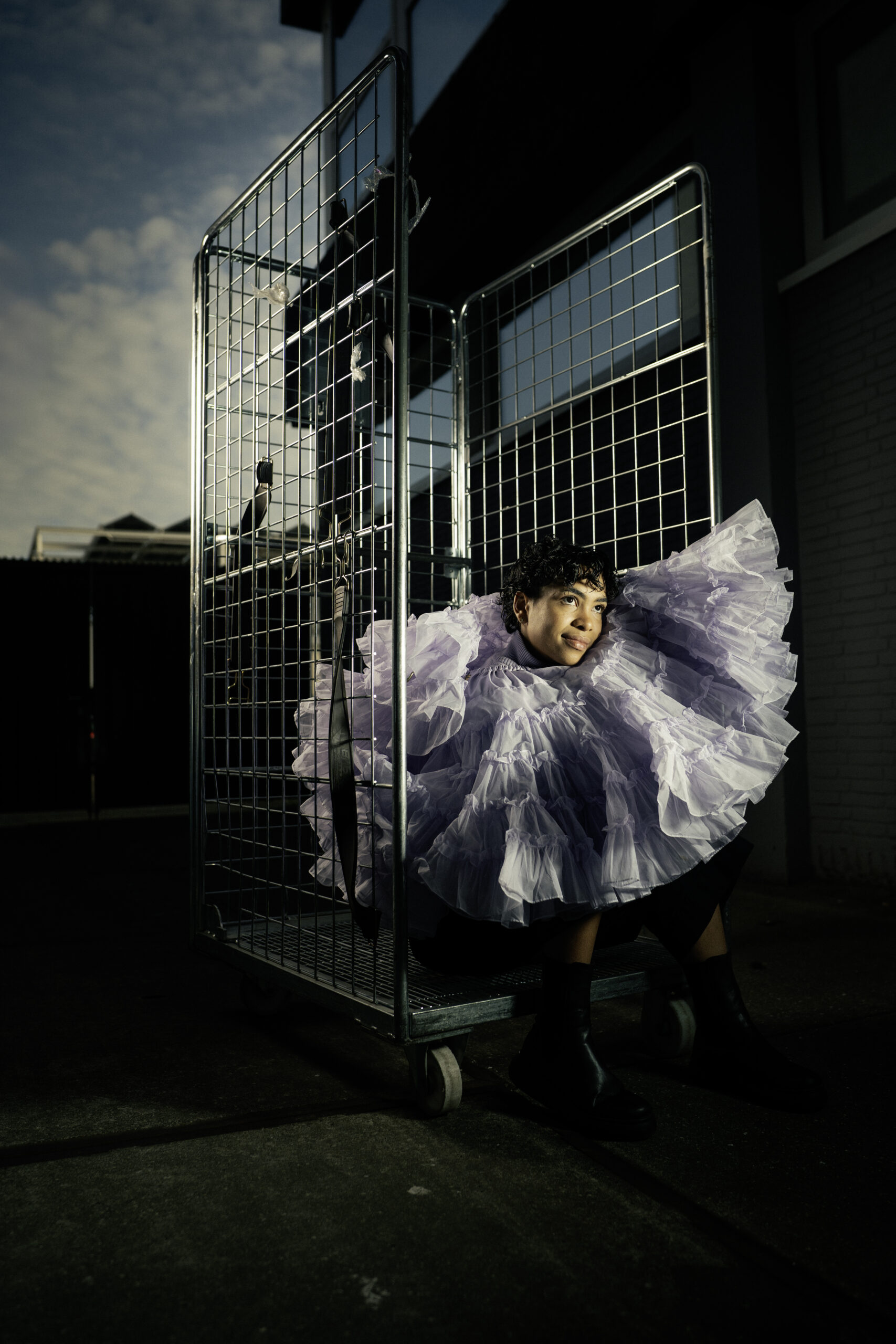
How do you recharge creatively and emotionally?
I would do long runs and hiking and try to go as far as possible by foot. I have been enjoying the Dutch dunes behind Haarlem a lot lately. In the darkest days of winter, you’ll most probably find me in the cinema. And throughout the year, speaking to other creatives, listening to whatever new crazy ideas and struggle they and we are going through is essential. This practice is very hard to build and sustain, you need a village. If you don’t have the village, make it digital. If you still can’t, I have noticed that diving very deep in other forms of arts that are far enough from yours really, really helps.These are music and film for me.
Can you define your methodology for collaborating with scientific institutions? What is the entry threshold for such alliances?
The ultimate question! I would say true interpersonal connections and synchronicity. I have met every single person I work with in person before working together. Wether be it in life in general, my experience is that things tend to last long and be more meaningful when it comes from a genuine connection between people. If it doesn’t work, it’s not meant to be. As a creative it’s important to know that our approach is a form of research, very different from the one of sciences but one should not come above the other. As scientist, engineer or institutions in general, it is important to not expect from the artist to simply illustrate whatever knowledge is produced.
I really enjoy my scene because I work with people who are extremely passionate and do not work from the ego. I value this a lot. So, there is no “entry threshold”, but if you read these lines and crave to meet people from a more scientific field, you should hangout in the same events and get closer to cultural spaces who already bridge these worlds : Waag Future labs, Leonardo, Universities, Open days in museums and research centers…
What brought you to Amsterdam? How has the transition been for you?
I have been in Amsterdam for 8 months now after 8 years in various cities of the Netherlands. Coming here was rarely an option as I knew the city for being very expensive. I was proposed the 3 Package Deal program with AFK, which meant mentoring in the city and commuting. Living at WOW has made this possible and I feel incredibly grateful.Since its my first months in town I am in a way still transitioning, but every day is a new surprise.
What are your thoughts on the Amsterdam art scene? How has WOW Lieven helped you build new connections?
Actually Amsterdam art scene is much more diverse than I thought. It is so big that there are many subs in the subs and it has this exhilarating city thrill to it. I am not sure I would have moved in Amsterdam if it wasn’t in WOW, because I knew that the city can also isolate you as much as it connects you. So the format of a soft residency like this building is very efficient. I have met people from very different fields, which is very inspiring.
What challenges do you face when creating new work, and how do you overcome them?
The biggest challenge is for me always to finish work. Connecting many layers has its pitfalls and this is one of them. This is why having this village/community/ contact with other creative is really useful. They help you cut things short and just put them out there.
How do you maintain financial stability in the often unpredictable art world?
It’s hard and it’s not getting better. But I often have this weird menu made out of freelancing jobs + short terms creative jobs + long term project with pay + unpaid things in between.
What five key elements do you consider essential for a sustainable artistic practice?
1, Be ok with surprising yourself when you expect it the least (let go).
2, External emotional support of any kind.
3, Remind yourself that no one knows shit and that you are made of many things in a huge universe so you’d rather be making art and also life is hopefully long so you don’t need to figure everything now and yes this is many answers in one.
4, If you find yourself fighting, ask yourself what you fight for not only what you fight against.
5. Your body holds many answers.
After graduating from the Design Academy Eindhoven, how did you adjust to post-student life?
I do feel like a student still, because I am always studying new things and a bit broke and working six days a week. But it was amazing, I have been very happy to leave school after two bachelors and 7 years there. It was time to experiment what my practice could be and how it could exist in the world.
Where do you see yourself artistically and personally in the next few years? Do you follow a plan or trust your instincts?
I have a plan and this plan might be for Amsterdam to be the last city I live in before retreating in the forest.
If you could be reincarnated as a plant or animal, what would you choose and why?
Maybe a Malfini, it’s an hawk from my home region and they are spread across many islands. I feel connected to them because they live in the mountains and they can be very fast and very slow. You often spot them gliding through air tunnels, it’s very soothing. I’d like to see the Caribbean from their point of view after my human life. And chill in hot air.
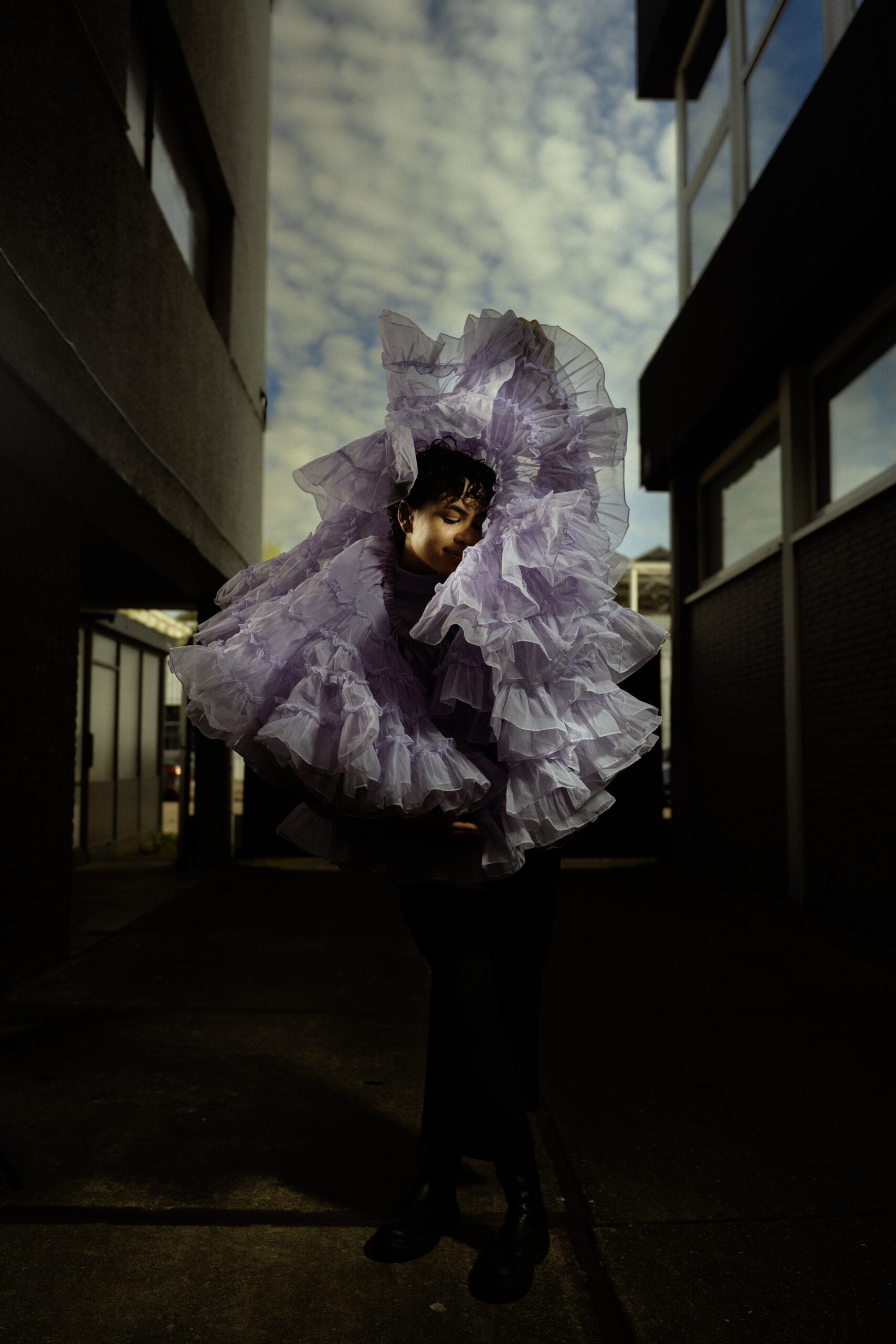
Photos by Roman Ermolaev
by WOW